🎵 “A VOICE FROM HEAVEN”: ROWAN ATKINSON & ADELE UNVEIL NEVER-BEFORE-HEARD DUET — A SONG THAT TRANSCENDS TIME
Rowan Atkinson and Adele have just created a moment that feels nothing short of extraordinary in music history.
For the first time ever, the two global superstars have unveiled a long-lost duet — a track so raw, emotional, and hauntingly beautiful that it feels like they are shaping something truly timeless together.
Titled “Shadows in the Light,” the song was reportedly rediscovered from old studio archives once believed to be lost forever.
Rowan Atkinson’s unmistakable, deeply emotional vocals blend seamlessly with Adele’s powerful, cinematic voice — creating a wave of passion, vulnerability, and deep emotional connection that lingers long after the final note fades.
More than just a song… it feels like a story.
A connection beyond time.

The idea alone is enough to stop fans in their tracks: Rowan Atkinson, the British performer known around the world for making audiences laugh, standing beside one of Britain's most celebrated vocalists for an emotional recording unlike anything associated with his famous comedy career.
In this imagined musical collaboration, “Shadows in the Light” does not attempt to transform Atkinson into a conventional pop star. Instead, its emotional appeal comes from the contrast between two performers audiences associate with completely different worlds.
Adele brings the soaring vocal intensity.
Atkinson brings something unexpected — an understated, theatrical presence shaped by decades of storytelling.
Together, the fictional pairing creates a song centered not on spectacle but on memory, loss, resilience, and the complicated passage of time.
The imagined recording reportedly begins almost in silence.
A restrained piano introduces a simple melody before Adele's voice emerges softly. Rather than immediately displaying the vocal power for which she is famous, she approaches the opening with vulnerability, allowing each word to breathe.
Then comes the surprise.
Atkinson enters not with the exaggerated personality of Mr. Bean or the sharp comic authority associated with Blackadder, but with a quiet, reflective delivery.
The contrast changes everything.
For decades, audiences have understood Rowan Atkinson through physical expression. He can communicate embarrassment through his eyes, suspicion through a raised eyebrow, or complete triumph through the smallest smile.
His greatest performances demonstrate that storytelling does not necessarily depend on words.
“Shadows in the Light” takes that principle and imagines it applied to music.
The fictional duet allows silence to matter just as much as sound.
There are spaces between the lines. There are moments where the piano almost disappears. Instead of overwhelming listeners with elaborate production, the arrangement leaves room for the emotional personalities of the two performers.
Adele's presence makes that approach especially powerful.
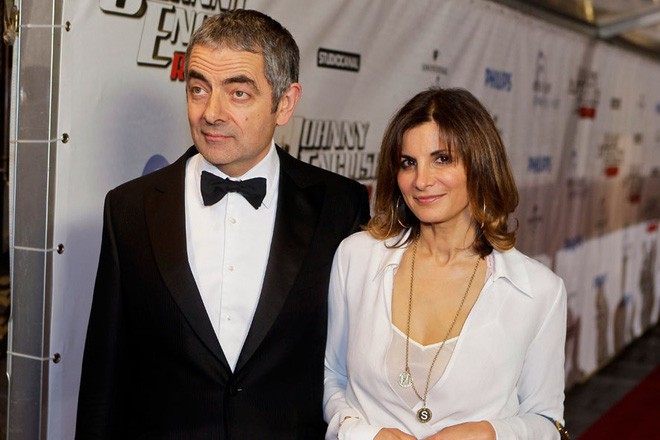
Her greatest strength has never simply been the technical size of her voice. It is the emotional directness she can bring to a lyric, making enormous audiences feel as though they are listening to something intensely personal.
Placed beside Atkinson's restrained theatricality, that quality creates an intriguing contrast.
One voice rises.
The other remains deliberately grounded.
Then, in the imagined chorus, they finally come together.
The result is not about vocal competition. It is about two dramatically different artistic identities meeting in the middle.
That is where the fictional title “Shadows in the Light” begins to make sense.
The song can be interpreted as a meditation on the parts of life people display publicly and the parts they keep hidden.
For Atkinson, that theme feels particularly appropriate.
Few performers are more recognizable internationally, yet his real personality remains far less familiar than his characters.
Millions know Mr. Bean.
They know the brown jacket, the red tie, Teddy, and the little green Mini. They remember the disastrous Christmas dinner, awkward encounters, elaborate schemes, and countless situations in which a simple problem becomes an extraordinary catastrophe.
But Rowan Atkinson himself has generally maintained a much quieter relationship with fame.
That creates the “shadow” behind the public light.
The entertainer everyone recognizes is also a private individual audiences rarely see without a character between them.
Adele's public image creates a different but complementary dynamic. Her music has frequently been associated with emotional openness, heartbreak, reflection, and personal transformation.
In this fictional collaboration, those two artistic identities collide.
The comedian becomes serious.
The singer becomes restrained.
And neither performs exactly as audiences expect.
As the imagined song progresses, its arrangement gradually expands. Strings emerge behind the piano, but the production never becomes overwhelming. Instead, the instrumental layers mirror the emotional progression of the story.
The final section strips everything back again.
No huge theatrical ending.
No explosive final note designed merely to impress.
Just two voices, a piano, and a few seconds of silence.
That imagined silence may be the most important part.
Atkinson has spent his career proving that silence can communicate enormous amounts of information.
Mr. Bean became internationally successful partly because audiences did not need extensive dialogue to understand what he was thinking.
A facial expression could replace a sentence.
A gesture could replace an explanation.
That same artistic principle gives “Shadows in the Light” its fictional emotional identity.
It also explains why the concept of Atkinson working with Adele is so fascinating.
On paper, the pairing seems almost impossible.
One is synonymous with visual comedy.
The other is synonymous with powerhouse vocals and deeply emotional songwriting.
Yet unexpected combinations often generate the greatest curiosity precisely because nobody knows what they will sound like.
Imagine the first studio session.
Adele behind the microphone.
Atkinson standing nearby.
No Mr. Bean expression.
No joke.
No attempt to turn the moment into comedy.
Instead, two British entertainers from dramatically different artistic traditions attempting to tell the same emotional story.
That image alone gives the fictional duet its appeal.
For longtime Atkinson fans, it also offers an opportunity to reconsider the range behind his comedy.
Blackadder demonstrated his command of dialogue and theatrical performance long before Mr. Bean became a global phenomenon. The Johnny English films later combined verbal and physical comedy on a much larger cinematic scale.
Across those projects, Atkinson repeatedly proved that his success depended on much more than funny facial expressions.
Timing, rhythm, tone, and emotional control have always been fundamental to his craft.
Those qualities are also fundamental to music.
That shared foundation provides the imaginative bridge between Atkinson and Adele.
Of course, “Shadows in the Light” should be understood as a fictional creative scenario rather than a verified real-world release. There is no established basis here for presenting a newly discovered Rowan Atkinson and Adele recording as an authenticated archival duet.
But as an imagined meeting of two extraordinary British performers, the concept works because it explores something audiences rarely get to see.
Rowan Atkinson without the punchline.
Adele without the enormous production.
Two voices occupying the same quiet space.
And a fictional song asking listeners to think about memory, time, vulnerability, and everything people leave unsaid.
More than a duet, “Shadows in the Light” becomes an imagined conversation between two artistic worlds.
One has spent decades making people laugh.
The other has made millions cry.
Together, at least within this fictional story, they create something somewhere between the two.
Something quiet.
Something unexpected.
Something that feels as though it could exist beyond time.




 LAVROV WARNS GERMANY: “DON’T PUSH RUSSIA TOWARD A REAL WAR”
 Germany says Russia was responsible for the incident; Moscow rejects the accusation as baseless. The dispute has already triggered retaliatory diplomatic measures from both sides.
 Moscow’s message: Russia will not be intimidated, but direct war between major powers would carry enormous consequences.