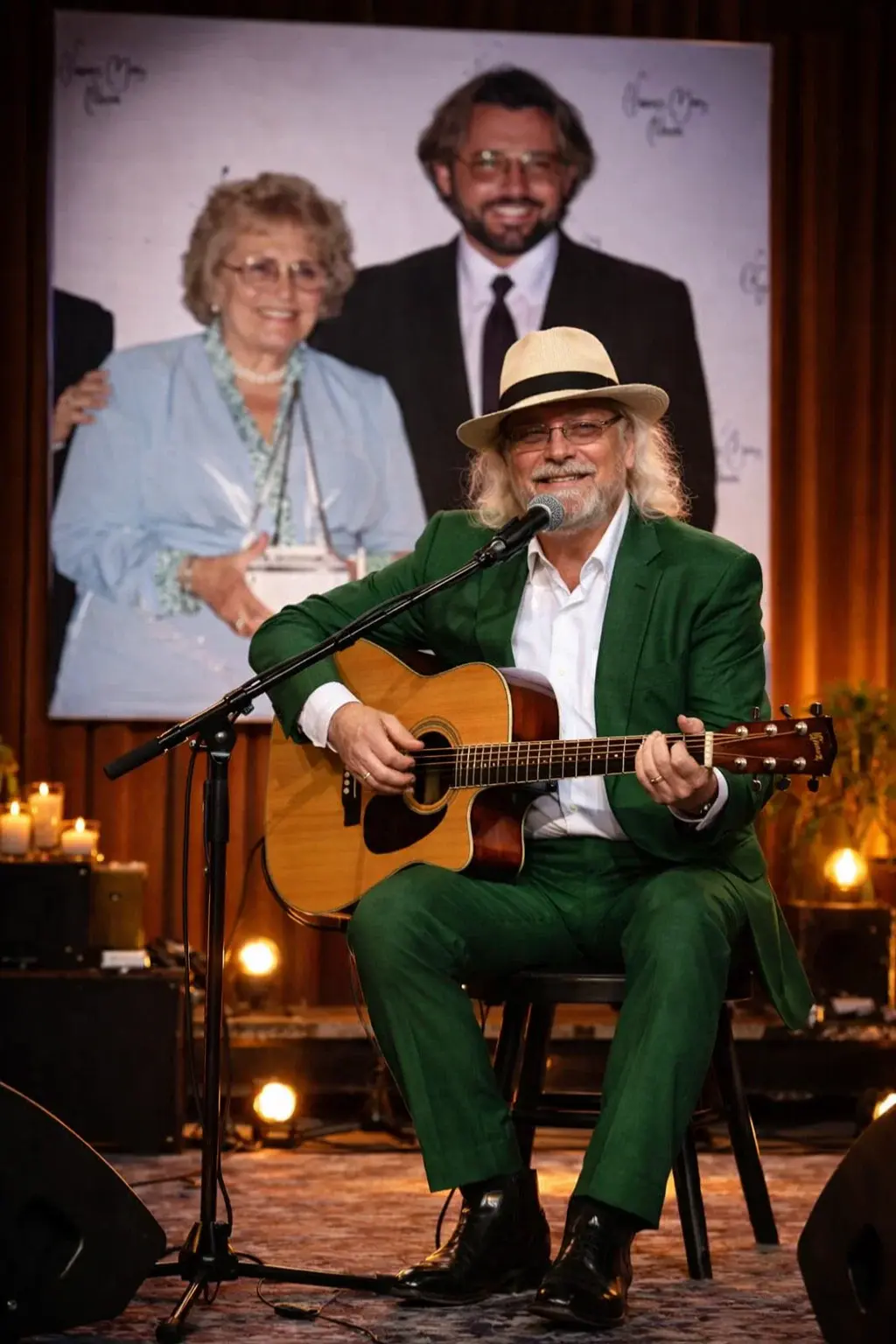

When the lights dimmed inside the packed arena and a single acoustic guitar rested against the glow of a soft spotlight, few among the 30,000 fans in attendance expected what would become one of the most emotionally charged moments of Barry Gibb’s storied career. The legendary singer, whose voice helped define an era of global pop and disco dominance with the Bee Gees, stepped forward quietly. There were no dramatic introductions, no elaborate stage effects. Just a man, a microphone, and a memory.
For decades, Barry Gibb has been associated with shimmering harmonies, falsetto brilliance, and stadium anthems that made entire generations dance. But on this particular night, the energy in the room shifted from celebration to reflection. As he adjusted the microphone stand and looked out across a sea of phone lights, he spoke softly about family, about gratitude, and about the woman who shaped his earliest dreams — his mother.
Those who have followed Gibb’s life know that family has always been at the center of his story. Born into a musical household, he and his brothers built a legacy that transcended genres and continents. Through triumph and unimaginable loss, Barry has remained the torchbearer of that legacy. Yet even icons carry private grief. And that evening, he chose to share it.
Without announcement, he began the unmistakable opening chords of “Mama I’m Coming Home.” The choice surprised many in the crowd. Though famously associated with another rock legend, the song’s theme of longing, return, and devotion resonated deeply in that moment. Barry’s voice — weathered by time yet still luminous — carried a vulnerability that silenced even the highest tiers of the arena.
“This one,” he said before the first verse, “is for my mum.”
The words hung in the air.
As he sang, the performance felt less like a cover and more like a conversation across time. Each lyric seemed to bridge earth and memory, as though he were reaching beyond the stage lights toward something unseen. The massive screens behind him showed simple imagery: black and white photographs of his childhood, snapshots of family gatherings, candid moments that revealed a young boy before fame reshaped his world.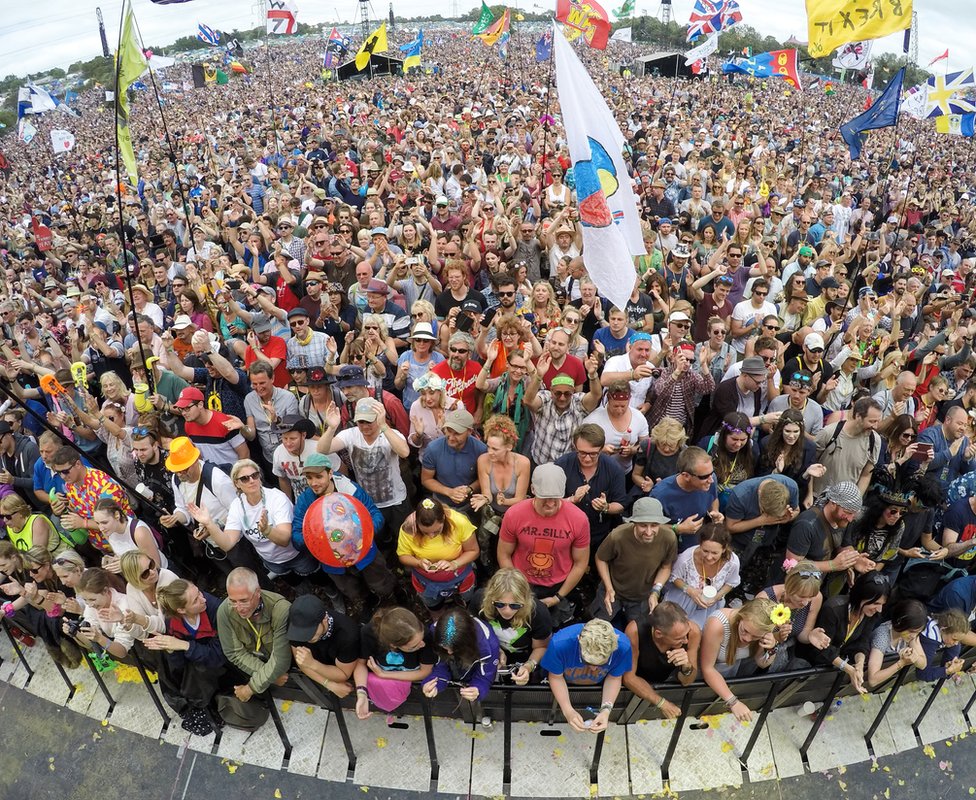
Fans later described the atmosphere as almost sacred. Thirty thousand people stood motionless, many with tears streaming down their faces. Couples clasped hands. Strangers embraced. The usual roar of a sold-out crowd was replaced by collective stillness. It was not the kind of silence born from boredom, but from reverence.
Barry’s voice trembled slightly during the second verse, and for a brief second he closed his eyes, steadying himself. When he reached the chorus, the audience joined in — softly at first, then stronger, creating a gentle choir beneath his lead vocal. It was not overpowering. It felt supportive, as if the crowd understood that this was not merely a performance, but a personal offering.
Throughout his career, Gibb has endured extraordinary highs and devastating losses. The passing of his brothers marked chapters of grief that the world watched from afar. Yet he has often spoken about his mother as the foundation — the quiet strength who believed in her sons before the world ever did. That belief, he once said in an interview, was the reason they dared to dream beyond their modest beginnings.
In that arena, as “Mama I’m Coming Home” echoed from speaker to speaker, it felt as though he was returning to that foundation. Not physically, but emotionally. The song became a bridge between generations — between a son and his mother, between an artist and his audience, between memory and presence.
Observers noted that Barry did not attempt vocal acrobatics or embellishments. He allowed the song to breathe. The arrangement remained stripped down — acoustic guitar, subtle strings, minimal percussion. The simplicity amplified the sincerity. It reminded listeners that sometimes the most powerful moments in music are not driven by spectacle, but by honesty.
By the final chorus, the crowd’s voices swelled again, this time louder, stronger, yet still respectful. The sight of 30,000 phone lights shimmering across the arena created a galaxy effect, as if stars themselves had gathered indoors. Barry looked out at the scene and smiled through visible emotion. When he sang the final line, his voice cracked just enough to make the moment human.
The last chord faded slowly.
For a heartbeat, there was silence.
Then the applause came — not explosive, not chaotic, but sustained and heartfelt. Many remained standing long after the music ended. Some wiped tears openly. Others simply stared at the stage, absorbing what they had witnessed.
In an era where concerts often compete for viral moments and headline-grabbing theatrics, this tribute stood apart. It was deeply personal, yet universally relatable. Nearly everyone in that arena could connect to the longing expressed in the song — the desire to say thank you, to say goodbye, or simply to feel close once more to someone who shaped their life.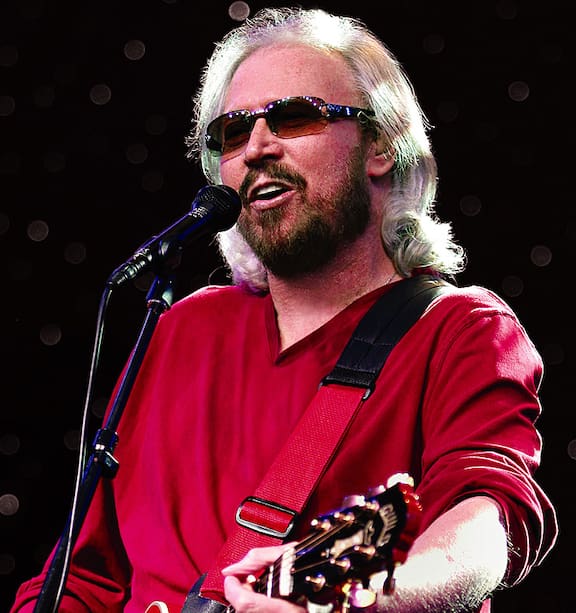
Music historians have long credited Barry Gibb with helping craft one of the most influential catalogs in modern popular music. From disco-era dominance to timeless ballads, his songwriting fingerprints are embedded across decades of charts. But nights like this remind audiences that behind the accolades stands a man who still carries the same core motivations that inspired him as a child: love, family, and remembrance.
Social media clips of the performance spread rapidly in the hours that followed. Viewers who were not present described feeling the emotion through their screens. Fans wrote about their own parents, their own losses, their own gratitude. What began as a single tribute became a shared space for reflection.
As the concert resumed and the tempo lifted once more, something intangible had changed. The connection between artist and audience felt deeper. The cheers that followed later songs carried an added layer of appreciation. It was as though the crowd understood that they had been invited into something private and were entrusted to carry it respectfully.
Long after the final encore, attendees filed out of the arena still discussing that one song. Not the chart-toppers. Not the dance-floor classics. But the quiet, heartfelt tribute that paused time.
Years from now, when people recount Barry Gibb’s enduring career, they will undoubtedly speak of record-breaking albums, iconic harmonies, and the soundtrack he provided to entire generations. Yet for those 30,000 fans who stood beneath the arena lights that night, the memory will center on something else.
A son singing to his mother.
A legend allowing himself to be vulnerable.
And a reminder that even the biggest stages in the world can become intimate when love is at the center of the music.
In that moment, Barry Gibb was not just a global icon.
He was simply a son saying, through song, “Mama, I’m coming home.”