GEORGE STRAIT’S REPORTED $3 MILLION GIFT TO DOLLY PARTON’S IMAGINATION LIBRARY HAS COUNTRY FANS EMOTIONAL — BUT THE MESSAGE BEHIND IT IS WHAT REALLY HIT HOME
Few names in country music carry the quiet authority of George Strait and Dolly Parton.
For decades, both artists have represented something larger than chart positions, record sales, awards, or sold-out concerts. They have become symbols of an era in which a simple melody and an honest story could travel from a small Southern town to millions of homes around the world.
Now, an emotional story circulating online is bringing those two legendary names together in an unexpected way.
According to the viral claim, George Strait reportedly donated an extraordinary $3 million to Dolly Parton’s Imagination Library, the celebrated book-gifting program associated with Parton and her Dollywood Foundation.
But as the story spread among country fans, it was not simply the enormous dollar amount that captured people's attention.
It was the message allegedly attached to it.
One line in particular has been widely shared:
“Three million dollars does not replace her. It just helps keep the mail going.”
The words are simple.
Almost painfully simple.
Yet within the context of the story, they carry a powerful idea: money cannot replace a person or everything she represents, but it can help continue a mission that has already touched countless children.
There is an important caveat. The $3 million donation and the quotation attributed to Strait have circulated as reported or viral claims, and they should not be presented as independently established facts without confirmation from Strait's representatives, the Dollywood Foundation, the Imagination Library, or another authoritative source.
But the reason the story has resonated so strongly is rooted in something very real: Dolly Parton's extraordinary commitment to childhood literacy and the remarkable cultural legacies of both artists.
A Gift About More Than Money
Three million dollars is an enormous amount of money.
Yet the viral story does not frame the supposed donation as a celebrity showing off his wealth.
Quite the opposite.
There is no giant ceremonial check in the narrative.
No elaborate stage announcement.
No attempt to turn generosity into a spectacle.
Instead, the story presents Strait's alleged gesture as something quiet and deeply personal—a country legend recognizing that another country legend created something capable of surviving beyond records and concert halls.
That distinction is precisely what makes the claim emotionally compelling.
Parton's Imagination Library is built around a remarkably straightforward concept: put books into the hands of children.
For a child, receiving a book in the mail can seem like a small event.
But childhood is often shaped by small events.
A package arrives.
A parent opens it with a child.
A story is read before bedtime.
A new word is learned.
An illustration creates a question.
A character sparks an idea.
And somewhere inside those moments, a child begins to understand that the world is bigger than the room they are sitting in.
That is why literacy programs can carry significance far beyond the physical books they distribute.
A book can become an invitation to imagine.
Dolly Parton's Mission Began With Family
The emotional foundation of Dolly Parton's literacy work has long been connected to her own family history.
Parton grew up in rural East Tennessee in a large family with limited financial resources. She has spoken publicly over the years about her father's inability to read and write, even while describing him with enormous admiration for his intelligence and work ethic.
That experience helped shape her interest in literacy.
When Parton launched the Imagination Library in the 1990s, the idea was initially connected to children in her home area of Sevier County, Tennessee.
What began locally grew dramatically.
The program eventually expanded far beyond Tennessee and beyond the United States, sending books to children in multiple countries.
Its success transformed Parton's public legacy.
To millions of people she was already Dolly Parton: the songwriter behind classics, the unmistakable voice, the glamorous entertainer, the actress, the entrepreneur and the woman with an instantly recognizable sense of humor.
But to countless families, she became something else.
She became the person whose name appeared on books arriving at their homes.
That connection is unusually intimate.
A concert happens once.
A television appearance ends.
But a children's book can remain on a shelf for years.
It can pass from one sibling to another.
It can be remembered decades later.
Why George Strait Fits This Story So Perfectly
George Strait's involvement makes the viral claim particularly compelling because his public image is defined by understatement.
Known to generations of fans as the “King of Country,” Strait built one of the most successful careers in country music without cultivating the kind of constantly provocative celebrity persona that dominates modern entertainment.
His image has always been comparatively simple.
A cowboy hat.
A guitar.
A microphone.
A song.
Then another song.
That restraint has become part of his identity.
Strait's music has often depended on emotional economy. The strongest moment does not necessarily require the longest explanation.
Sometimes a single sentence can carry an entire story.
That is exactly how the alleged note works.
“Three million dollars does not replace her. It just helps keep the mail going.”
Whether ultimately authenticated or not, the line sounds almost like a country lyric.
There is grief in it.
There is practicality in it.
And there is an image anyone can understand: books continuing to arrive in children's mailboxes.
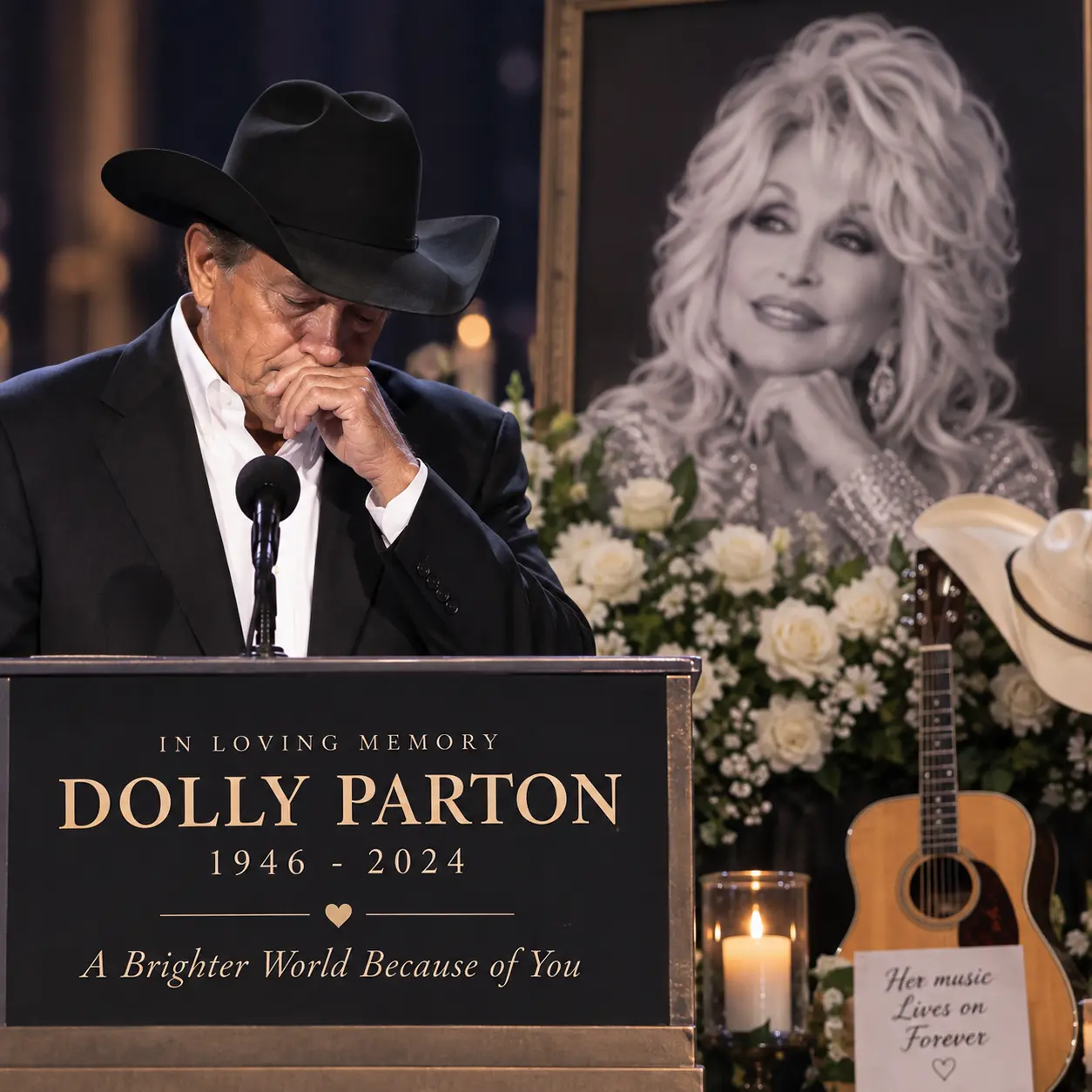
But one part of the wording also requires particular caution. The phrase “does not replace her” can easily be interpreted as implying that Dolly Parton has died. That should not be assumed from a viral graphic or post. Any claim about a public figure's death requires reliable, current confirmation.
The meaningful part of the underlying idea does not depend on such an implication.
Helping a literacy mission continue is powerful while its founder is alive, too.
Songs and Stories
The reported message surrounding the donation also draws a connection between songs and books.
It is an appropriate comparison.
Country music is fundamentally a storytelling tradition.
Some of its greatest songs contain an entire life inside three or four minutes.
A marriage begins.
A relationship collapses.
A child leaves home.
Someone loses a parent.
Someone falls in love.
Someone makes a mistake.
Someone asks for forgiveness.
Someone gets one final chance.
Dolly Parton understands that power as well as almost anyone in American music.
Songs such as “Coat of Many Colors” demonstrate how a childhood memory can become a universal story about poverty, dignity, family and love.
“Jolene” turns insecurity and fear into an unforgettable plea.
“I Will Always Love You” makes separation tender rather than cruel.
The details may come from one person's experience, but the emotions become everyone's.
Books can work the same way.
A child may never visit the place described on a page.
They may never meet someone like the protagonist.
But through a story, they temporarily inhabit another person's world.
That is where imagination begins.
And imagination can become ambition.
A Different Kind of Legacy
Artists spend careers building legacies.
Usually those legacies are measured in familiar ways.
Number-one singles.
Albums sold.
Awards won.
Tickets purchased.
Streaming totals.
Hall of Fame inductions.
But eventually another question appears:
What remains beyond the music?
For Parton, the answer includes her commitment to literacy.
That may ultimately become one of the most enduring aspects of her public life.
Children receiving books today may be too young to know “9 to 5.”
They may never have watched one of her films.
They may not understand why their grandparents immediately recognize her voice.
But they can understand receiving a book with their name on the package.
That is a remarkable kind of cultural reach.
It transforms celebrity into infrastructure.
Instead of simply being admired, a famous name helps create a system that repeatedly delivers something useful.
If a fellow artist were to support that mission financially, the symbolism would therefore be enormous.
One storyteller helping another storyteller create millions more readers.
Why Fans Find the Story So Emotional
The response to the viral claim is also about time.
Strait and Parton belong to a generation of country artists whose careers span decades.
For many fans, they are connected to memories of parents and grandparents.
Their songs played during long drives.
They were heard in kitchens on Sunday mornings.
They were played at weddings and funerals.
They were on radios inside pickup trucks and small-town restaurants.
They became part of the background music of ordinary American life.
As those artists grow older, fans experience their accomplishments differently.
A collaboration feels more precious.
A tribute feels heavier.
An old photograph means more.
People begin thinking not only about what these artists accomplished but about what will happen to the institutions, traditions and charitable projects associated with them in the future.
That anxiety gives the alleged Strait quotation its emotional power.
“Keep the mail going.”
The phrase is not really about mail.
It is about continuity.
Keep the books going.
Keep the children reading.
Keep the dream alive.
Keep doing the work.
Imagine the Child at the Other End
It is easy to discuss a multimillion-dollar donation in abstract terms.
But imagine the program from the other side.
Somewhere, a parent opens a mailbox.
Inside is a book addressed to a young child.
The child may live in a family surrounded by books.
Or perhaps there are very few books in the home.
Maybe a parent immediately sits down to read.
Maybe an older sibling takes over.
Maybe the child carries the book everywhere for a week.
Maybe that particular story becomes the first book they learn to read independently.
No celebrity is standing there.
No cameras are present.
No one applauds.
Yet that quiet moment may matter more than the publicity surrounding any donation.
This is the difference between charity as spectacle and charity as infrastructure.
The most meaningful result often occurs when nobody famous is watching.
George Strait's Own Legacy
Strait hardly needs another headline to establish his place in country music history.
His catalog and longevity already speak for themselves.
He became a defining figure in traditional country music while the industry changed around him repeatedly.
Trends came and disappeared.
New formats arrived.
Radio changed.
Streaming transformed how audiences consumed music.
Yet Strait's reputation endured.
Part of that longevity came from consistency.
He never needed to reinvent himself into something unrecognizable simply to remain relevant.
Fans knew what they were getting.
That sense of steadiness is why the idea of a quiet philanthropic gesture fits naturally with the image audiences have of him.
But fitting an image is not the same as proving a claim.
That distinction deserves repeating because misinformation often succeeds precisely when a fictional event seems perfectly consistent with what people already believe about someone.
A believable story still requires evidence.
Dolly's Greatest Song May Not Be a Song
There is a poetic argument that one of Parton's greatest creations is not a composition at all.
It is a reader.
A child who receives books may develop stronger reading habits.
That child may become a student who loves literature.
That student may become a teacher, writer, scientist, nurse, engineer, musician or parent who reads to another generation.
No one can predict the path.
That is the point.
Opportunity rarely produces one predetermined outcome.
It creates possibilities.
Parton understood that books can open doors before a child even knows those doors exist.
For someone who built a career through imagination, it is an extraordinarily appropriate mission.
She imagined songs before anyone heard them.
She imagined a career beyond the mountains where she grew up.
She imagined businesses.
She imagined characters.
And then she helped children receive the tools to imagine lives of their own.
Generosity Without the Spotlight
Celebrity philanthropy often receives cynical reactions.
Sometimes that skepticism is justified.
Charity can be used for publicity.
But the best philanthropic work eventually becomes bigger than the celebrity associated with it.
People stop caring about the photograph of the donation.
They care about whether the work continues.
Are books arriving?
Are children reading?
Are communities participating?
Is the mission sustainable?
That is why the phrase “keep the mail going” is so effective.
It reduces a huge concept to one visible action.
The mail arrives tomorrow.
Then next month.
Then for another child.
Then another.
That is how institutions survive.
Not through one emotional moment, but through repetition.
One Legend Honoring Another
Country music has always been unusually conscious of lineage.
Young performers talk about the artists who influenced them.
Veterans invite newcomers onto stages.
Songs are covered across generations.
Old guitars are preserved.
Historic venues become sacred ground.
Tributes matter because the genre understands that no artist begins from nothing.
Everyone inherits something.
A melody.
A tradition.
A style of storytelling.
A stage built by somebody else.
The viral story about Strait and Parton extends that tradition beyond music.
Instead of one singer covering another singer's song, it imagines one legend helping protect another legend's humanitarian work.
That is why fans respond emotionally.
The gesture says: what you built matters enough to continue.
There may be no greater compliment.
The Truth Matters Too
The emotional power of this story should not eliminate the need for verification.
As inspiring as the reported $3 million donation sounds, readers should distinguish between a viral claim and a confirmed announcement.
The same applies to the quotation attributed to Strait.
If confirmation emerges from Strait's official representatives, the Imagination Library, the Dollywood Foundation, or another reliable source, the details can then be reported accordingly.
Until then, the responsible wording is “reported,” “claimed,” or “circulating online.”
That caution does not weaken the story.
In fact, it honors the values the story celebrates.
Books matter because words matter.
Literacy matters because understanding words helps people distinguish truth from fiction.
A campaign devoted to reading deserves nothing less than careful reading from the people discussing it.
More Than Three Million Dollars
Ultimately, the reason this story has captured so much attention is not really the number.
Three million dollars makes the headline dramatic.
But the deeper idea is much smaller and much more human.
A child.
A mailbox.
A book.
A parent turning the first page.
A bedtime story.
A question.
A dream.
Then another book arrives.
And another.
That is how a legacy moves forward—not as a monument frozen in the past, but as an action repeated in the present.
George Strait and Dolly Parton have already given country music more than most artists could dream of giving.
Their songs have crossed generations.
Their names have become part of American culture.
And the literacy mission associated with Parton demonstrates that storytelling can continue long after the microphone is turned off.
If the reported donation is ultimately confirmed, it would represent a remarkable gesture from one country legend toward another's life's work.
If the specific claim remains unverified, the enormous reaction to it still reveals something meaningful.
People want stories about generosity.
They want legends to honor one another.
They want success to produce something beyond wealth and fame.
And they want the things that help children dream to continue.
Perhaps that is why five simple words hidden inside the alleged message carry more emotional weight than the millions attached to the headline:
“Just helps keep the mail going.”
Because behind every package is a child.
Behind every book is a story.
And behind every story is the possibility that one young reader will open a page and discover a world they never knew existed.
That is a legacy worth protecting.